
Description
Valve Types & Applications
Below is an organized overview of the most common sanitary valve types and their typical uses.
Butterfly Valves
Function: On/off or throttling
Key Features:
- Compact, economical design
- Minimal dead space
- PTFE or encapsulated seals
CIP/SIP compatible
Applications: Transfer lines, tank outlets, CIP return loops
- Sizes: 1″ to 6″ (DN25–DN150)
Ball Valves
Function: Positive shut‑off
Key Features:
- Full‑bore design
- 2‑way and 3‑way configurations
- Blow‑out‑proof stem
Micro‑polished ball for smooth operation
Applications: Sampling points, ingredient addition, flow diversion
- Sizes: 1/2″ to 4″ (DN15–DN100)
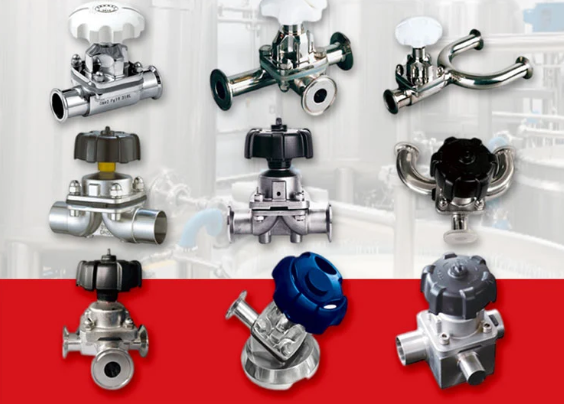
Diaphragm Valves
Function: Sterile isolation
Key Features:
- No internal cavities
- Diaphragm separates product from mechanical components
Ideal for aseptic processing
Applications: WFI (Water for Injection), pure steam, pharmaceutical filling
- Sizes: 1/2″ to 4″ (DN15–DN100)
Check Valves
Function: Prevent backflow
Key Features:
- Spring‑assisted closure
- Low cracking pressure
Ball or disc‑style designs
Applications: Pump protection, preventing product mixing in shared lines
- Sizes: 1/2″ to 4″ (DN15–DN100)
Mixproof Valves
Function: Prevent cross‑contamination
Key Features:
- Dual independent seals
- Leak detection chamber
Allows two products to run through one valve safely
Applications: Multi‑product beverage and dairy pipelines
- Sizes: 1″ to 5″ (DN25–DN125)
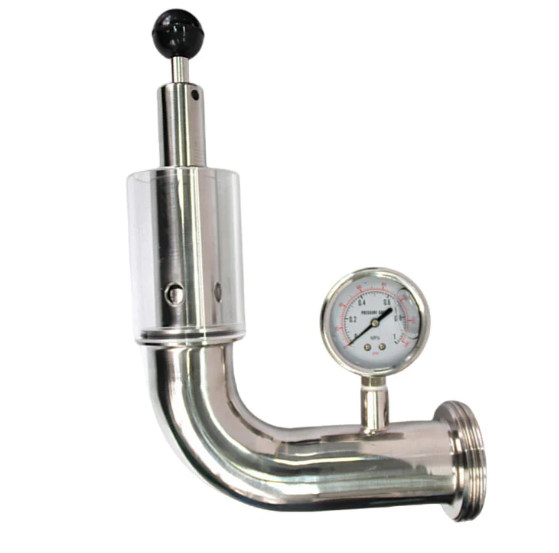
Pressure Relief Valves
Function: System over‑pressure protection
Key Features:
- Hygienic spring‑loaded design
- Adjustable set pressure
Protects tanks and pipelines
Applications: Tank venting, line pressure control
- Sizes: 1″ to 3″ (DN25–DN80)
Seal Material Selection Guide
| Seal Material | Temperature Range | Chemical Resistance | Typical Uses | Compliance |
| EPDM | -20°C to +140°C | Excellent for hot water, steam, acids, alkalis | CIP/SIP, dairy, brewing | FDA, 3‑A, EC 1935/2004 |
| Silicone | -50°C to +180°C | Good for oils, weak acids | High‑temp processes, pharma | FDA, USP Class VI |
| PTFE | -200°C to +260°C | Nearly universal chemical resistance | Aggressive chemicals, ultra‑pure systems | FDA, USP Class VI |
| FKM (Viton) | -20°C to +200°C | Excellent for oils, solvents, aromatics | Essential oils, chemical processing | FDA (select grades) |
Frequently Asked Questions
How do I choose between a butterfly valve and a ball valve?
- Butterfly valves are cost‑effective for larger lines (2″ and above) and work well for general on/off control.
- Ball valves provide bubble‑tight shut‑off and are ideal for smaller lines or applications requiring precise isolation or multi‑port flow paths.
What does CIP/SIP capable mean?
A CIP/SIP‑capable valve can withstand high‑temperature cleaning chemicals (CIP) and saturated steam sterilization (SIP). The design ensures all wetted surfaces are fully exposed to cleaning agents and drain completely.
When is a mixproof valve required?
Mixproof valves are used when two different products share the same piping system but must never contact each other. The dual‑seal design prevents cross‑contamination and reduces downtime between product changeovers.
What does Ra 0.5 µm surface finish mean?
Ra measures surface roughness. A finish of 0.5 µm is extremely smooth, minimizing microbial retention and improving cleanability. It is commonly required for pharmaceutical and aseptic applications.
<3>How do I specify a valve for high‑purity water systems (WFI)?
Look for:
- Diaphragm or sterile ball valve design
- Electropolished finish (Ra ≤ 0.5 µm)
- Fully drainable orientation
- PTFE or high‑purity EPDM seals
- SIP‑ready construction
- Documentation for validation (DQ/IQ/OQ)
Why Choose Our Sanitary Valves
Our sanitary valve lineup is engineered for hygienic processing environments where reliability, cleanability, and compliance are essential. Each valve is built with high‑grade materials, smooth internal finishes, and seal options suitable for a wide range of applications. Whether you need simple flow control or advanced mixproof technology, we offer solutions that support safe, efficient, and contamination‑free production.


Reviews
There are no reviews yet.